I like charcoal because it allows me to cover large areas of paper with fewer strokes than a drawing pencil does. In addition, the loosely compressed carbon in charcoals allows me to smear and blend the strokes to get the effects I want (something not quickly done with a grade-H lead drawing pencil).
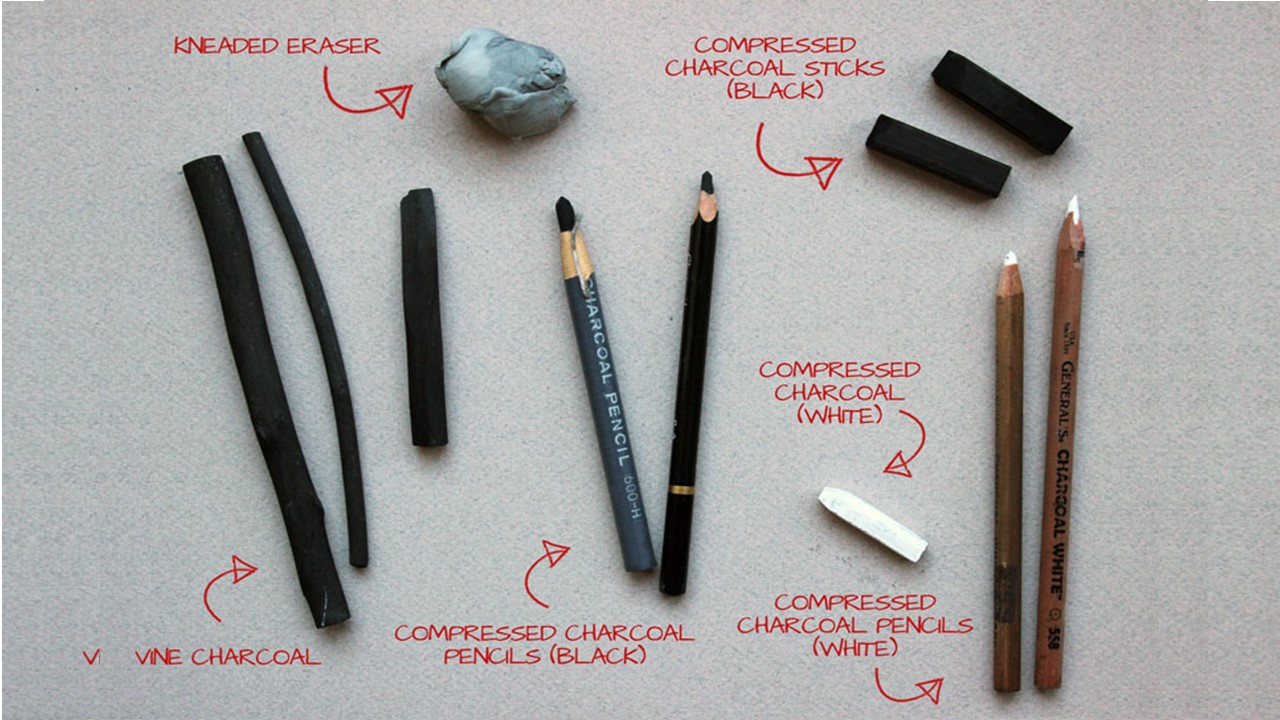
Here are a few different charcoal types to consider:
✓ Vine charcoal sticks: These are sold in boxes in various hardnesses (hard, medium, and soft). They’re great for loosely blocking the overall shape of the figure and applying shading on areas of the body. I like using the extra-soft vine sticks when shading in my figure because they’re quick, and I can get darker shadows without pressing too hard against the paper.
✓ Thick charcoal sticks: As the name suggests, thick charcoal sticks are the thicker versions of the thinner vine charcoal. Though not practical for small figures or detail, they make excellent shading tools (especially on large drawings, such as a closeup of the torso on an 18-x-24-inch drawing pad).
✓ Compressed charcoal pencils: These come in various degrees of hardness (hard, medium, and soft). Think of them as pencils with charcoal instead of graphite. I like using them to draw figure details (such as the eyes, nose, and fingernails). Charcoal pencils come in handy when your figure drawing is smaller than 8 x 10 inches.
✓ Compressed charcoal sticks: These cylindrical charcoal sticks come in hard, medium, and soft variations. I like using them to draw loose gesture lines and curves of the figure. The advantage of using these rather than charcoal pencils is that you never have to worry about shaving away any wooden casing around the charcoal — the powder charcoal particles are tightly compressed by using binders.
You may find that using a smooth versus rougher paper surface affects which type of charcoal you use. Suppose you’re planning to draw from the figure continuously for an extended period (for example, an all-day figure-drawing session). In that case, I recommend using softer charcoal over harder charcoal because it eases the resistance on the paper and, ultimately, the stress on your hand. Softer charcoals also make getting a deeper range of values easier without pressing hard on the paper.
 The Art of Richard Romero