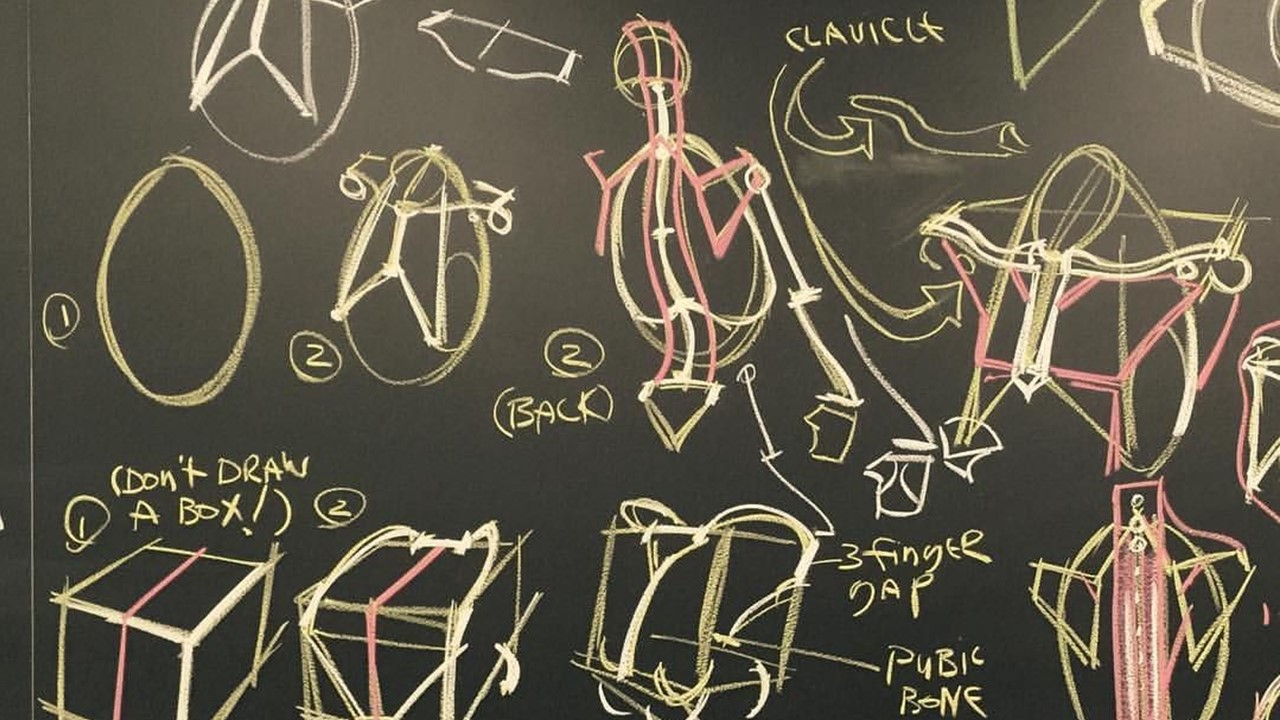
The Constructed Figure

In today’s fast-paced society, where days and weeks seem to rush by more quickly than ever, it seems the only time we stop to appreciate our amazingly constructed figures is at 6 a.m. when we look in the mirror to brush our teeth or apply makeup. Most people aren’t even in touch with what their bodies look like (especially the backside). Our bodies, which come in all shapes and sizes, are complex and wonderfully crafted works of art that deserve more attention.
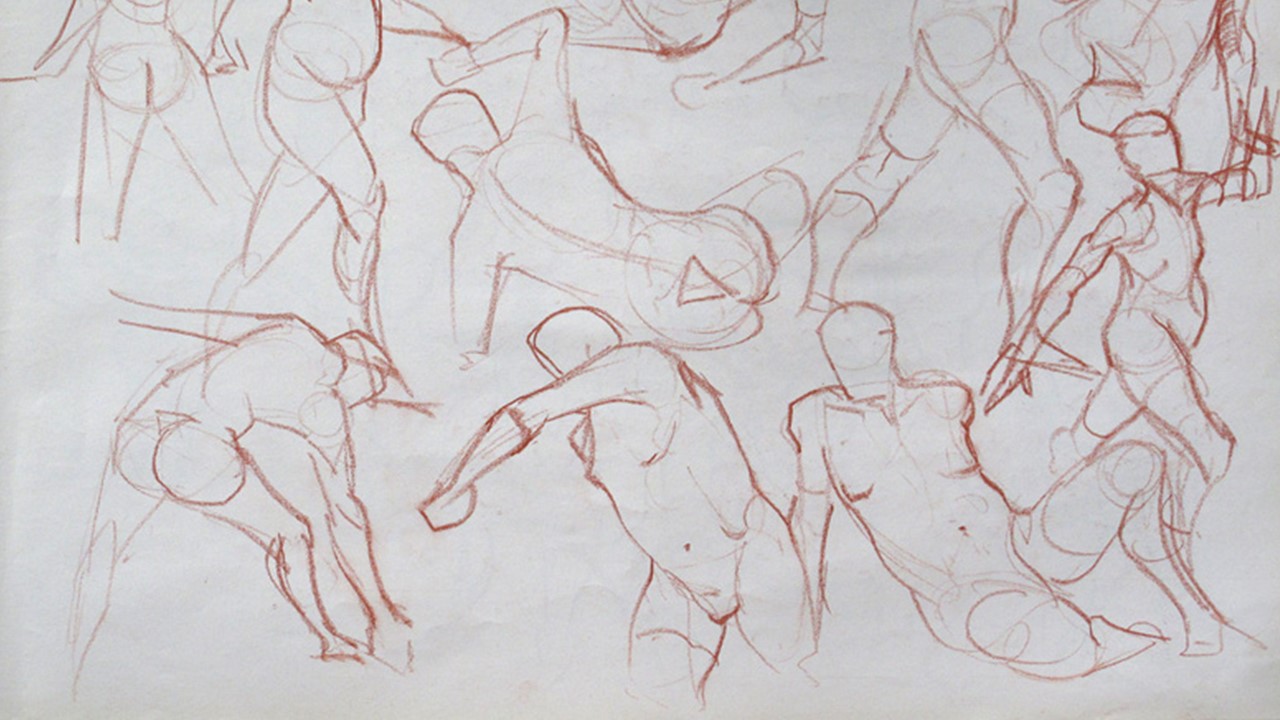
Figure-drawing students approach me on the first day of class, claiming they can draw only stick figures, but most gain two things by the end of the first session. One: they realize how beautiful yet complex the body is. Two: they realize how talented they are and how fun it is to apply their skills to drawing the human figure. Whether you’re an art student, a professional illustrator wanting to brush up on your figure-drawing skills, or just someone who likes to doodle and wants some guidance on drawing the figure, learning figure drawing is a great place to start.
Drawing the Head

No part of the human figure draws more attention than the head. It’s the area we use to recognize one another. The features that incorporate all five senses are also located on the head. I give you a heads-up on the following topics:
✓ The head’s basic shape: In its most simple form, the basic head shape is essentially a spherical object that at first glance looks like an egg. As the figure matures from infancy to adulthood, the bone structures adjust to the growing proportion of the body in part by fusing together. I walk you through different techniques for drawing the basic shape of the head at different ages and from different views.
✓ Facial features: When you examine the head more closely, you’ll find that it consists of a series of complex interlocking bones covered with cartilage for the nose and ears and multiple layers of muscle groups that control the movements of the jaw and mouth. And don’t forget the eyes!
✓ Hair: Although hair consists of hundreds of individual stands, they cluster together in an organized fashion to form waves and curls (or they simply cascade down like a waterfall). I walk you through exercises that explore using different textures to add realism to the hairstyles and types without worrying about drawing every single strand (that’s an in-hair-ently insane task).
✓ Facial expressions: Our facial muscle structure is literally skin deep! Just the slightest twitch or reaction gives away the most subtle thought going through the mind (I, for one, have a terrible poker face!). However, these nuances make the face the center of attention in most figure studies. I describe the muscle structure of the face and give you pointers on drawing various facial expressions.

The dynamics of form

Back when I was starting my art training, it was hard to find a course in artistic anatomy. Anatomy classes had been phased out of most art school and art department curriculums in the United States. The change started in the mid twentieth century, when abstract expressionism and then pop art, conceptualism, and minimalism became the primary focus in art schools, replacing older artistic traditions. Yes, there were still ateliers that offered anatomy classes, but very few. I myself was scoffed at by teachers and other artists for trying to obtain knowledge of anatomy. They told me the subject was antiquated, too complicated, no longer necessary, and that I was wasting my time pursuing such an outdated topic.

This hostile attitude, however, ignited a rebellious desire on my part, and I continued, as best I could, to study the human figure in the classical way. I began collecting as many artistic and medical anatomy books as I could find, and I started a rigorous routine of reading the material and passionately drawing from live models to make all that information come alive in my work. I found that understanding the dynamics of form, structure, and movement gave my drawings and paintings an aesthetic edge. I wasn’t just “reporting” bio-mechanical information; I was using that information to enhance my art and take it to another level.

THE CRANIUM, WITH SOME FACIAL FEATURES SUPERIMPOSED

Let’s look at a few individual components of the cranium. The frontal bone, commonly called the forehead, is a bony plate situated at the upper front of the cranium above the eye sockets. It is similar in shape to the back of a crab, as shown in this drawing shown here. The outer borders, which are called the temple lines (superior temporal lines), are helpful in indicating the plane change that occurs from the front of the head to the side. The brow ridge (superciliary arch) is the slightly thickened portion above the eye sockets; males tend to have thicker brow ridges than females. The glabella is a smooth prominence above the root of the nose. The frontal eminences are two large, slightly bulging forms positioned side by side in the general forehead region.

Artistic pursuits

From the beginning of my artistic pursuits, I’ve always felt strongly that the study of anatomy is vital for understanding the human figure. This was the main reason I was attracted to artistic anatomy—though I admit that I was also eager to take on the challenge of learning such a difficult subject. But as a teacher of figurative art, I realize that many artists are intimidated by anatomy’s sometimes overwhelming complexity. And so I feel the responsibility to pass on to others the knowledge that I have gained, and to present the anatomical material in an accurate yet easy-to understand format accessible to any artist who needs or wants the information.

Knowledge is power

 The English philosopher Francis Bacon said, “Knowledge is power,” and that’s certainly true for artists: Understanding something well gives an artist more power to create what he or she wants to create. Over the years, I’ve often known figurative artists who wanted to take their art in certain creative directions but who kept hitting a dead end because they didn’t really understand the basic anatomical elements of the human form. Then, when they acquired this knowledge—to whatever degree they felt was sufficient—their figurative work was transformed.


For an artist, anatomical knowledge shouldn’t be an end in itself. Instead, it should inspire and enhance an artist’s creative work. When artists take the guesswork out of anatomy and truly understand the body’s structures and mechanisms, they can open up to a more intuitive level when solving certain problems in their figurative work.

The basic bones of the cranium

 The following drawing shows the basic bones of the cranium. Many of the bones’ features are covered by facial muscles, which are themselves obscured by a layer of subcutaneous fatty tissue. But knowing the placement of these bones will greatly help you understand where certain facial muscles or soft-tissue forms attach.

Self-conscious

And anyone who can draw can always improve. The world we live in is a highly visual one, and we are increasingly communicating through pictures. But, in contrast to those instantaneous visual blasts, the process of drawing encourages us to take the time to really look at another person, objects and our surroundings. The response we create with marks on a tactile surface demonstrates the effort to see and understand those things better. 

Many of us fall out of drawing at a young age, some of us keep drawing sporadically and a few of us make it part of our day-to-day routine. Although most children enjoy drawing and painting, as we grow up we often become self-conscious about it and frustrated when our pictures don’t come out as we intended. Although some people have a natural aptitude for drawing, the ability to draw isn’t a talent that you are born with; it’s a skill, like learning to play an instrument, or another language, that requires patience and practice.

Drawing the human figure

When drawing the human figure, artists look for various surface landmarks. These can be soft surface forms, such as muscles, tendons, ligaments, and fatty tissue, or hard surface forms, which are places where evidence of the skeleton can be seen on the surface of the body. Hard surface forms are also known as bony landmarks— parts of bones (ridges, bumps, depressions) that are positioned close to the skin, creating visual landmarks on the surface form.

The following drawings provide a general guide to where the main bony landmarks are, as seen from both the anterior and posterior views. Whether you can see these skeletal clues on a live model will depend on both the pose and the model’s body type. On some figures, fatty tissue may obscure much of the evidence of the bones, while on leaner figures it will be easier to see bone definition at several places on their bodies.

PICTURE MAKING

 A drawing can be a picture; a representation of a thing we have seen or imagined. Drawing as a process is an immediate way of structuring an observation or bringing an idea into being. Painters, printmakers and anybody making pictures and objects in any medium will benefit from developing fundamental drawing skills. Drawing as a sensibility can extend beyond the conventional mediums we associate with it; sketches can be made in paint, film, built in three-dimensions and so on.